

Fiscal & macro‑framework
-
- GDP growth of around 4.1% in 2025, and expected to be similar in 2026.
- Inflation forecast at about 2.2% for 2026.
- Budget deficit projected to fall to approx. 2.8% of GDP in 2026 (below the EU’s 3% ceiling) thanks to stronger revenues and controlled spending.
- Public debt to stabilise around 46‑47% of GDP — well under the EU’s 60% threshold.
Measures for Individuals & Families
-
- The Cost‑of‑Living Allowance (COLA) will increase by €4.66 per week.
- The first‑time home‑buyer scheme is made permanent.
- For inherited property that is the owner’s primary residence: the duty rate is reduced to 3.5% on the first €400,000 (previously on first €200,000).
- Free school transport and free childcare continue; also new supports for adoptions (domestic and abroad) and better parental‑leave entitlements.
- Increased in‑work benefits and child allowances for low‑income families.
Personal taxation
-
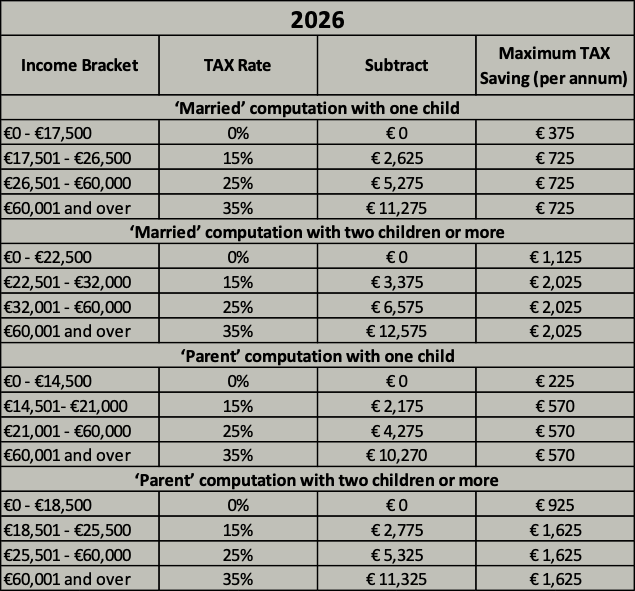
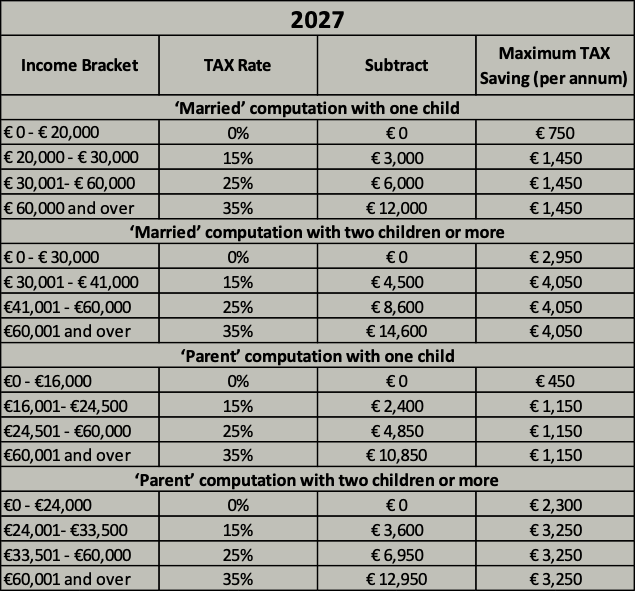
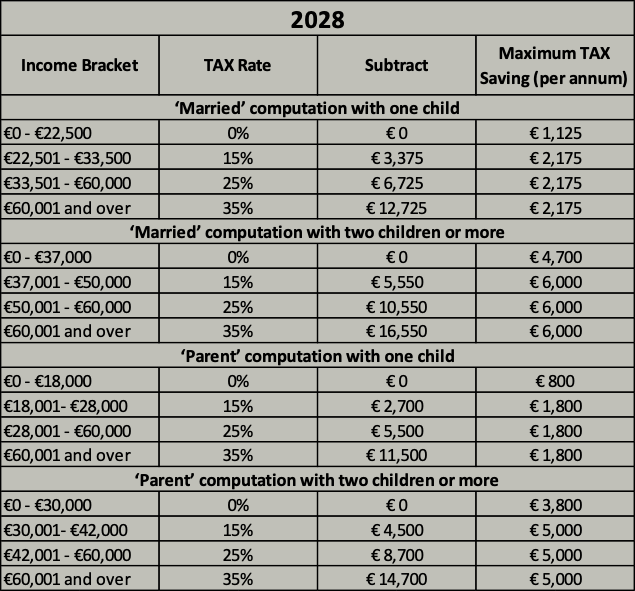
- Over the next three years, families with children under 18 years of age (or under 23 if in full-time education) will benefit from reduced tax rates.
- Two new tax bands — “parent” and “married” — will be introduced for:
-
- Families with one child, and
- Families with two or more children.
-
- The existing “married” rates will remain applicable for qualifying individuals who do not meet the criteria for the new bands (e.g., households where only one spouse is employed).
The new applicable rates and the maximum tax savings are outlined in the tables below.
Measures for Businesses
Several incentives targeting companies, SMEs, digitalisation and R&D:
-
- The popular Micro Invest tax credit scheme for Maltese businesses will increase the maximum tax credit to €65,000 for Malta‑based businesses, €85,000 for Gozo‑based.
- Introduction of a new investment tax credit: 60% of qualifying capital expenditure, claimable over four years.
- Accelerated tax depreciation over 2 years for qualifying investments in digitalisation, automation and cybersecurity.
- 175% tax deduction for eligible R&D expenditures.
- Indirect tax: e.g., the eco‑contribution for tourism will increase from €0.50 to €1.50 per night.
- No new major corporate tax increases announced; the tone is investment‑friendly.
Property / Succession / Real‑Estate
Some of the property‑specific measures and reforms:
-
- The reduced duty on inherited primary‑residence property (3.5% on first €400k) as noted above.
- A ten‑year land‑registration strategy will be implemented to modernise property records, deal with emphyteusis and long‑term leases.
- The First‑Time Buyers Scheme remains in force permanently: important for clients seeking to purchase their first home.
Other Noteworthy Items & Strategic Priorities
-
- Demographic challenge: the Government emphasises the very low birth rate in Malta and treats the family‐support tax measures as part of the response.
- Digitalisation / AI / automation: the Budget signals that investment in digital infrastructure / automation / cybersecurity is a priority.
- Planning / infrastructure: some focus on land reclamation projects and long‑term infrastructure.
- Energy / cost of living: subsidies on energy continue; Government stresses that it will maintain stability in bills and energy support even as inflation moderates.
For more information, kindly contact Apex Business Services on 21559999 or info@jcordina-andco.com.


